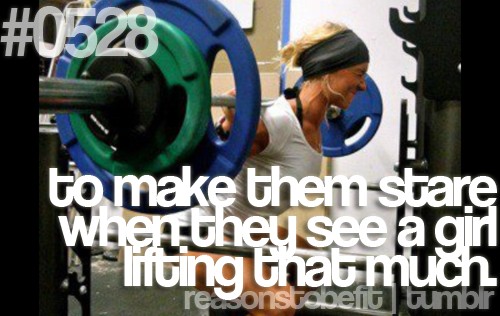
I stumbled across this picture sometime last week during one of my weekly “find cool pictures to use in blog-post” sessions, and it pissed me off. The cluttered text is aesthetically displeasing, and that bothers me. This clearly isn’t a good example of graphic design.
If I get nitpicky about squat technique, I’d like to see her sit back more. In regards to depth, this better be mid-range and not the bottom.
Most importantly though, it plays into female/strength training stereotypes: The idea that women women would be lifting just “to make them stare”, and that women can’t lift “that much”.
Training for the sake of gaining people’s attention at the gym is asinine. Unless you have a training partner who provides form feedback, it really doesn’t matter what other people are looking at while you train. As for the “that much” comment, a 200lb squat isn’t all that impressive. It’s not very common, but it’s also not very heavy.
Our media-fueled culture is full of 9 Minute Abs, Yogalates, Brazilian Booty Blast, and a host of related exercise programs that confuse sweating with effective strength training. We hear about high rep, light weight sets that ‘”tone” and “sculpt”, and after weeks and months most look exactly the same. If you’re strength training, you should probably get strong in the process, right?
Consider the question, “How much should I be lifting?”
Simple: As much as you can.
The most important word there is you. It’s not about gender, or size, or a self-limiting ceiling you put on your strength levels when you decide a weight is too much. Pick up something heavy, and then improve upon that the next time you feel ready.
Progressive Overload has long ruled as an important factor in strength training. It’s a simple increase in training stress over a period of time, and there are nearly infinite ways to do to this: manipulating training volume, relative intensity, tempo of a lift. These are all important factors to consider with a well structured training program, but we can’t forget that strength training is about getting strong(er). Pick up heavy shit.
Obviously, ‘heavy’ is relative. What’s heavy for me is speed weight for elite level powerlifters. Then again, around some of the 10 x 10 bicep curls crowd at school, I might actually look strong. Regardless of how much is on the bar though, you should feel like you’re working hard.
In the past few weeks I’ve had several people, both male and female, asking me about how much they should put on the bar. If I create my own stereotypes, I usually find myself encouraging women to add weight to the bar, and insisting that men take weight off and correct technique. I’m all about getting strong, but when it’s health enhancing, not debilitating. Do it the right way.
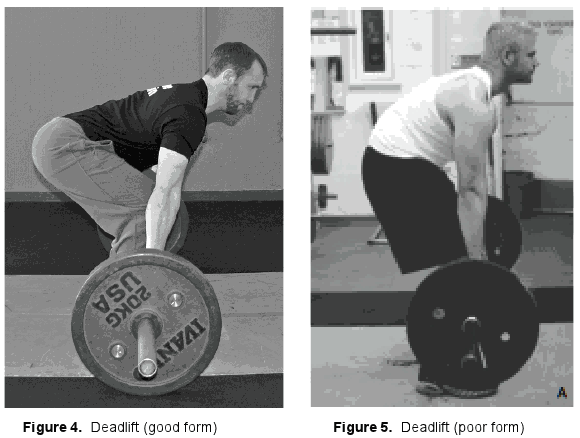
Once someone can replicate good form on any given exercise, I’m all about training for strength. Male or female, 16 or 60, blue collar job or white collar job. Wherever you are in your life, getting stronger can help you live a happier and healthier life. There are obviously benefits to each and every type of exercise, but if we’re looking at the most effective ways to train, getting stronger is always going to help.




 Harold Gibbons | MovementGPS
Leave a comment