After a 13 day run of blog posts, I wasn’t able to write something. I was busy finishing a lab for exercise physiology in reference to our submaximal steady state evaluation and predicted VO2 maximum. After answering some questions regarding my predicted VO2 max, I had to write a 10 week program of aerobic exercise to improve my fitness levels. The ‘average’ VO2 max is between 30-40 ml/kg/min, and my VO2 max was predicted at around 56.03 mL/kg/min, without very much ‘dedicated’ aerobic work. I probably won’t be using the program I had to write; drat!
Now, I’m not quite sure you’ve heard of VO2 max, and if you have, you may not exactly know what it is. That’s okay; it’s not all that confusing. During exercise, your body consumes oxygen in relation to the amount of energy required to continue a task. Unfortunately, the amount of oxygen doesn’t grow forever; eventually, we can’t consume any more oxygen. A variety of reasons can contribute to higher levels of oxygen consumption, but according to THIS article, cardiac output is the limiting factor:
There is undeniable scientific evidence to support the conclusion that it is the ability of the cardiorespiratory system to deliver O2 to the muscles and not the ability of the mitochondria to consume O2 that is the limitation to VO2 max. This relates to healthy subjects performing maximal, large muscle mass exercise (Saltin and Strange 1992; Basset and Howley 2000; Richardson 2000). Basset and Howley (2000) identify maximal cardiac output as the major factor limiting VO2 max during bicycling and running tests. There is no single central limiting factor to VO2 max. Just as O2 delivery involves an integrated pathway, any factor which reduces the delivery of O2 to the mitochondria, will limit VO2 max (Basset and Howley 2000; Richardson 2000).If you’re still confused, that’s fine; VO2 max is basically a measure of aerobic fitness. It is linked to overall fitness and all cause mortality, and having a higher VO2 max generally means you’re healthier. Below is a chart of normative values for age and gender:
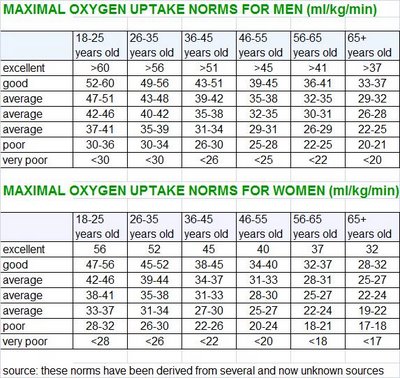
Makes sense, right? No, probably not, because VO2 max is a measure that’s often used in a clinical setting and seldom used out ‘in the real world’. Without a maximal exercise test, it’s only possible to predict VO2 max, and prediction equations can vary up to 15%. The number I presented before was an average of 3 tests; a 12 minute run, a cycle ergometer test, and the Queens College Step Test. Each test provided a different estimate, and I averaged the three to come to 56.03 mL/kg/min. According to the normative values above, this is pretty good, right? (It’s certainly better than national averages, but those take into account that 2/3 of our population is sedentary; not exactly the best barometer of fitness.) If you’re interested in some quick submaximal testing to estimate your VO2 max, you can find examples of tests HERE. That link includes 24 variations of tests that you can use if you don’t have access to a labratory and expensive equipment like this:.
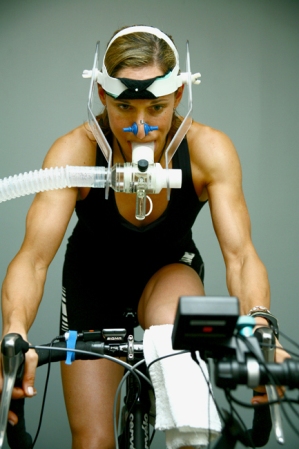
For endurance athletes, aerobic fitness is extremely important. VO2 max is driven to its genetic ceiling, and anaerobic threshold is optimized so work can be sustained at a higher level of oxygen consumption. It’s like maintaining your cars best fuel economy at really high speeds. That would be pretty darn cool, wouldn’t it? Figure that one out, Audi!
Endurance athletes have levels of oxygen consumption that are particularly high due to the high intensity/ high volume nature of training, as well as due to their genetic gifts; some of them just picked the right parents. If you’re interested in those values, here are some of the highest measurements of VO2 maximum:
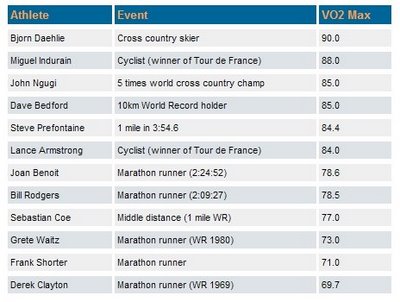 Now aerobic performance is important, and these athletes certainly display significant levels of oxygen consumption. It’s not that surprising if they’re world class, world record holding athletes. Many of their careers are made or broken by their VO2 consumption. Unless you’re an elite endurance athlete, your success (or health) isn’t determined by your oxygen consumption. As important as it cardiovascular fitness is, VO2 max is over rated.
Do you care about your VO2 max? I don’t think so. You care about looking better naked, performing better, and not having a heart attack or stroke at age 50. Traditional aerobic training isn’t necessarily the best for improving any of these measures, but it’s routinely used, usually unsuccessfully, by people trying to ‘improve’. Improve on what?
Having a ‘base’ level of aerobic fitness is important; I agree with that. Unfortunately, this is not a case of ‘more is better’. If moderate aerobic exercise for 150 minutes a week (30 minutes, 5 days per week) is the ‘minimum’ requirement for aerobic fitness, then 420 hours a week (60 minutes, 7 days a week) of vigorous activity must be better, right!?
No.
If you’re incapable of completing higher intensity exercise, then moderate level aerobic training may be recommended. (If you have an underlying medical condition, or you’ve been sedentary for a while, that’s probably you.) If not, move on to bigger and better things, my friend. I’ll reuse one of my favorite pictures to save a thousand words. Think about which of these individuals does more aerobic training, and likely has a higher VO2 max. Then, think about which one is probably healthier, looks better naked, and has a level of fitness that can be applied to a greater variety of daily activities.
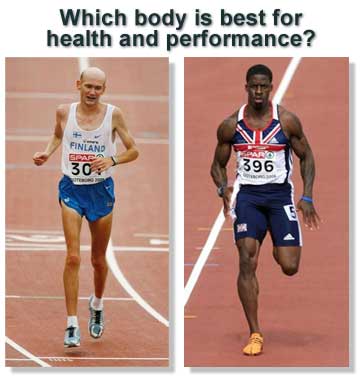
A balance of strength training, interval training, and some moderate aerobic activity is going to give you the best overall results for health, performance, and aesthetics. Unless you’re an endurance athlete (and even if you’re an endurance athlete), you should focus a good portion of your exercise efforts on getting stronger, and improving your anaerobic conditioning. Properly strength training, as well as performing high intensity interval training, is going to give you better results in less time than you’d spend complaining about how boring your steady state cardio is. Sure, you VO2 max may not be as high, but you’re going to feel better, look better, and live a healthier life. Plus, you’ll also notice increases in your aerobic power as a ‘side effect’ of this training.
Let’s finish this post off with a great video from genius strength coach and master of logic Mike Boyle. If you’re an endurance fanatic, you probably won’t like what he’s saying, but if you’re looking for the most effective training you can find, I’d listen to what the good coach has to say. It seems so logical, you may never want to go ‘jogging’ again.




 Harold Gibbons | MovementGPS
Leave a reply to Gavin Downes Cancel reply